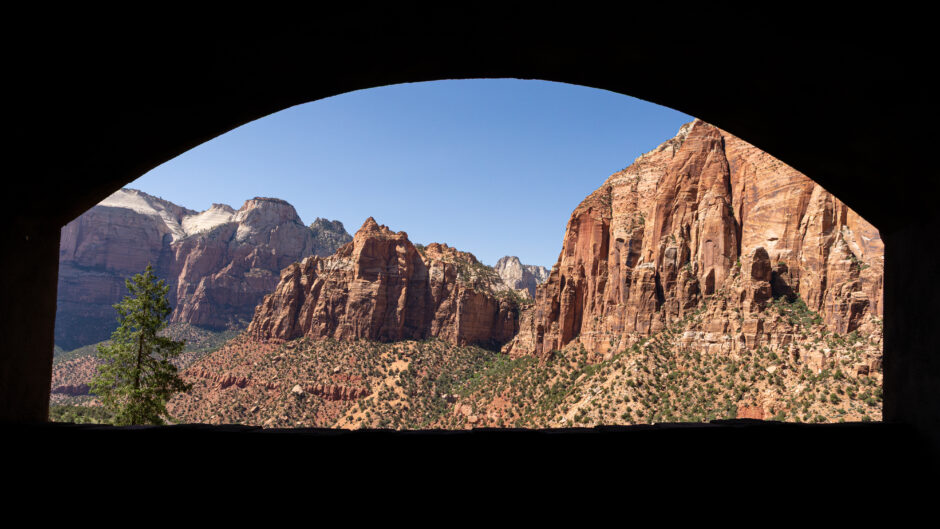
How to Get This Shot: Window into Zion (a.k.a. Drive-By Photography at 20 MPH)
There are few things in photography more frustrating than invisioning a killer photo and being told, “Cool, you get about two seconds to make that work.” Welcome to the Zion-Mount Carmel Tunnel.
If you’ve driven through Zion National Park, you know the tunnel. If you haven’t, picture this: a mile-long bore blasted through sandstone in the 1920s, with massive “windows” carved into the cliff wall so drivers wouldn’t completely lose their minds in the dark. These openings weren’t built for photographers. They were built so early motorists wouldn’t drive straight into a rock wall. Naturally, we’ve turned them into a photo opportunity.
A Bit of History (That Actually Matters)
The Zion-Mount Carmel Tunnel was completed in 1930 and was a major engineering feat at the time, connecting the floor of Zion Canyon with the park’s higher altitude east side. It wasn’t just drilled straight through the rock like some clean, modern highway project. It was a full-on, brute-force operation in the late 1920s. Crews started by blasting those now-famous gallery windows into the cliff face. From there, they worked inward, carving out the tunnel from multiple access points and slowly connecting both ends through the mountain.
Those windows weren’t built for photographs. They were practical. Crews used them to dump blasted rock out of the tunnel (you can still see the piles of debris below each window). Bringing in light and air, the windows made the job much safer and slightly less miserable.
In the early days, motorists were actually allowed to stop at these openings and look out over the canyon. It was treated as a scenic stop, which sounds great until you remember this is a dark, narrow tunnel with oncoming traffic. Unsurprisingly, that didn’t end well. Too many accidents led to the system we have today, with timed, one-way traffic control and a strict no-stopping rule.
Now, as a park guide, I love these windows for a completely different reason. They act as the perfect teaser. You’re driving through darkness, and then suddenly, BAM! there’s this blast of light and a glimpse of Zion’s cliffs. People start leaning toward the windows, you hear the “oohs” and “ahhs,” and then you pop out the other side into the full canyon. It’s one of the best built-in reveals in any national park.
The Reality of Getting the Shot
What those engineers probably didn’t realize is that they were also creating one of the most effective “natural” framing tools you’ll find anywhere in landscape photography. The problem is, you can’t stop in the tunnel. No pulling over, no tripod, no second chances. If you try to stop, at best you’ll get honked at. At worst, ticketed by the National Park Service and asked to leave the park.
To make this work, you need to be driving westbound from the east entrance. You need to be sitting on the right side of the vehicle, and your window needs to be down. Shooting through glass will destroy contrast and introduce reflections that will absolutely show up later. Ideally, your driver understands what you’re trying to do and keeps things smooth and steady. Traffic is controlled anyway, so you’ll be moving slowly, but you’re still working with seconds.
Use the First Two Windows (Seriously)
There are 5 windows in total. The first two windows you pass are smaller and not nearly as scenic. Perfect. These are your setup shots.
Use them to confirm exposure, make sure your framing is close, and check that your burst mode is firing properly. This is not the time to wing it. Take a few frames, glance at your results if you can, and lock things in. When the 3 larger windows show up, you won’t have time to adjust anything.
Camera Settings for This Shot
This is not your typical landscape setup. Here are my shot stats:
- Camera: Sony a1
- Lens: Sony FE 14mm f/1.8 GM
- Aperture: f/8
- Shutter Speed: 1/3200 sec
- ISO: 2000
The fast shutter speed is doing the heavy lifting here. At 1/3200 sec, I’m freezing the motion of the vehicle and my own handholding. The aperture at f/8 gives enough depth of field for the canyon, and the ISO is simply the price of admission. You can clean up noise later. You cannot fix motion blur. At 14mm, I cropped in a bit for these final frames. So, in theory, you could get away with something closer to a 24mm. That being said, I’d rather crop than cut off the full wrap around frame, so don’t go too zoomed in.
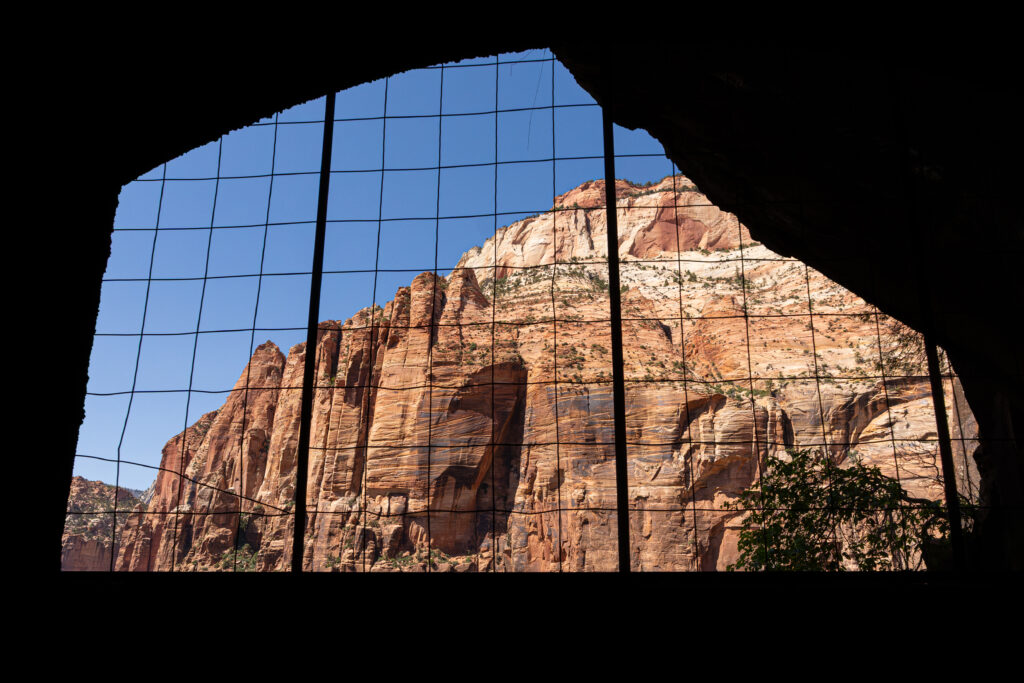
Why the Composition Works
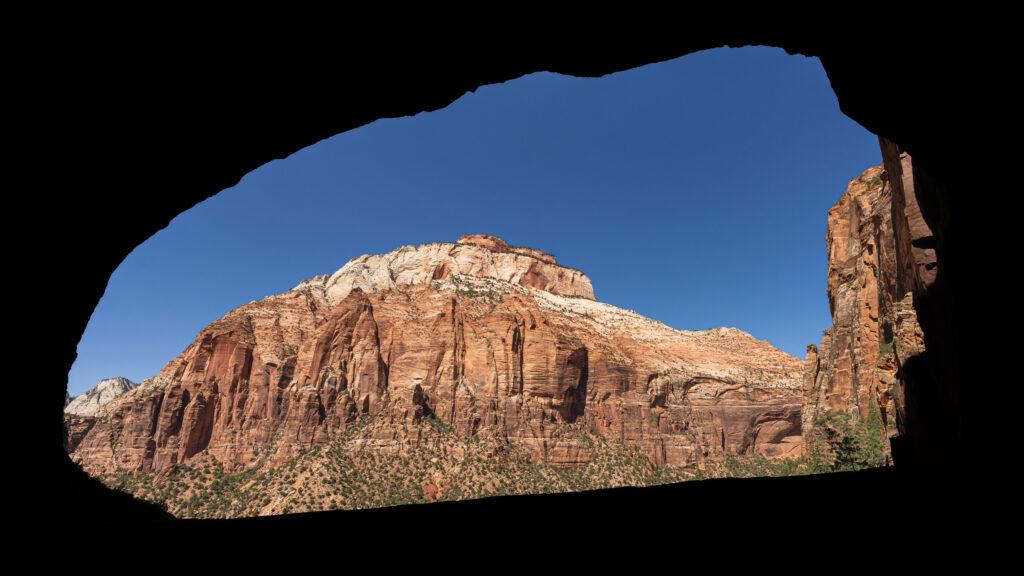
This shot is not about Zion alone. It’s about where you’re standing when you take it. The tunnel opening acts as a frame; creating a built-in vignette that draws your eye straight to the canyon while adding depth and context. You’re not just looking at cliffs, you’re looking out from inside a mountain.
That contrast between the dark interior and bright exterior is what makes the image pop. The framing gives the scene structure, something you’d have to work hard to create anywhere else. Here, it’s handed to you. You just have to recognize it and react fast enough to use it.
Burst Mode Is Not Optional
You are not timing this perfectly. The window slides past you in seconds, and your angle is constantly changing as the car moves.
So don’t try to nail one shot. Set your focus on the far canyon wall, hold down the shutter, and let it rip. If your camera sounds like it’s having a war flashback, you’re doing it right. You’ll sort through the frames later and find the one where everything lines up.
Common Mistakes to Avoid
Don’t shoot through glass. Don’t ignore the first two windows. Don’t hesitate when the main opening appears. And don’t assume your exposure is fine without checking. The contrast between the dark tunnel and bright canyon is extreme, so meter for the outside scene.
Final Thoughts
This is not a calm, tripod-based landscape photo. It’s fast, reactive, and a little chaotic. And that’s exactly why it’s fun.
You’re working within tight constraints, using the environment in a creative way, and capturing something most people will never make an image of. Those are often the shots that stick.
If you find yourself on our Grand Canyon, Bryce & Zion Expedition, this is one of those sneaky moments I always keep in mind. Everyone gets excited about the overlooks, but sometimes it’s the in-between opportunities like this that produce something a little different. Just make sure your lens cap is off before you hit the dark tunnel.
Happy Photographing,

Leave a reply