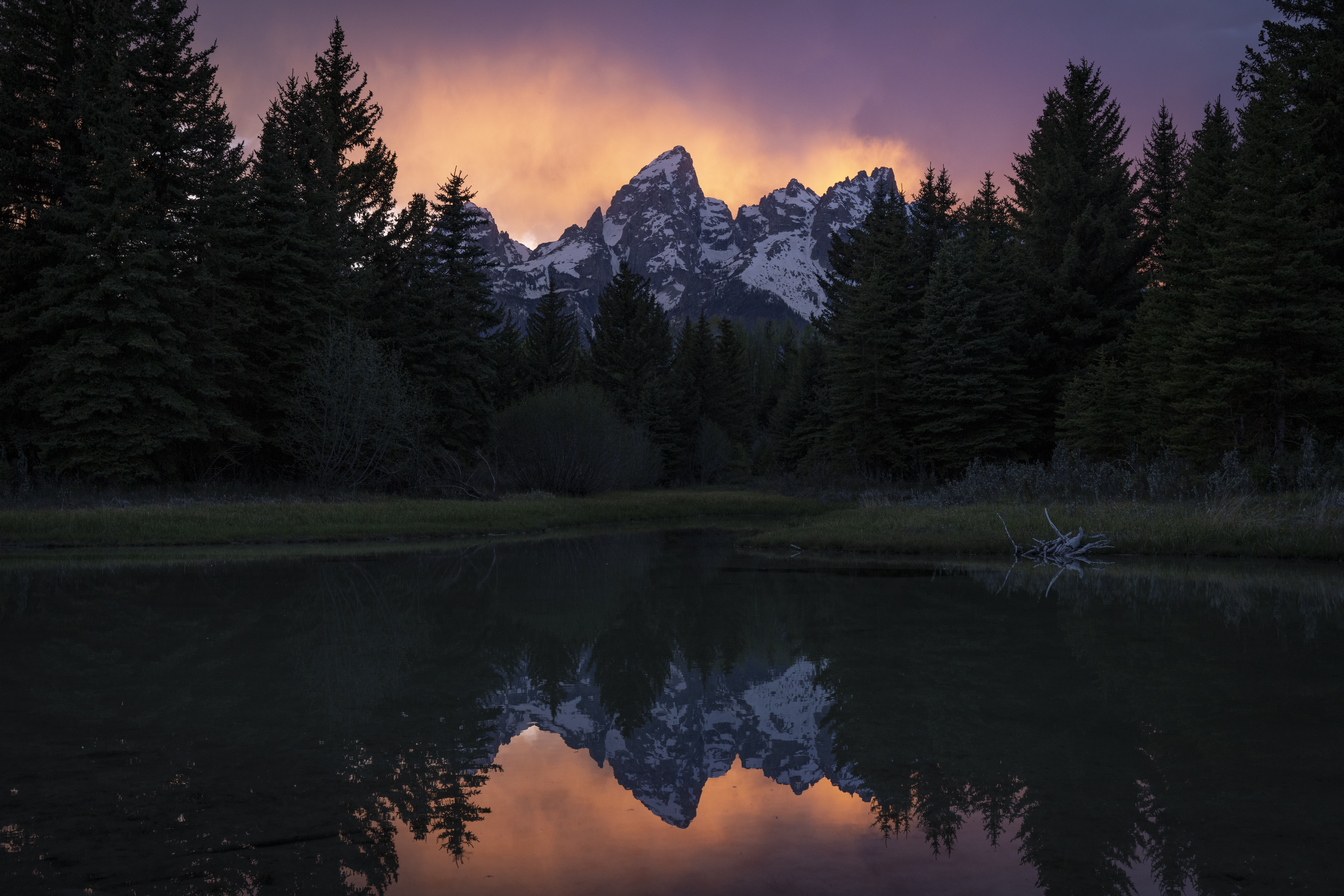
How to Get this Shot: Sunset in the Tetons
There are certain photography locations that have become so iconic that they almost work against you. You arrive, set up your tripod, look around at the twenty-seven other photographers standing in exactly the same spot, and wonder if there’s any chance of creating something that doesn’t immediately look like the postcard photo from the gift shop.
Schwabacher Landing in Grand Teton National Park is one of those places. And honestly? It’s famous for a reason.
On calm mornings and evenings, the Snake River side channel becomes a giant mirror, reflecting the jagged skyline of the Tetons with almost ridiculous perfection. Most people call Grand Teton National Park a “sunrise park” as the North to South mountain range glows as the sun peeks over the eastern horizon. But, add clouds at the right altitude and you’ve also got a sunset saturation behind the peaks of the most photogenic landscapes in North America.
This image was taken during sunset after a stormy evening. The clouds were beginning to break apart behind the mountains, allowing the last light of the day to illuminate the sky. What made the scene work was the contrast between the fiery colors in the clouds and the cool blues of the landscape below. Nature was doing all the heavy lifting, I just had to be patient.
Camera Settings
- Sony a1
- 24-70mm Lens @ 44mm
- ISO 400
- f/9
- 1/60 sec
One of the first surprises for many photographers is that this wasn’t taken with an ultra-wide lens. In fact, I was zoomed in to 44mm.
When people first arrive at Schwabacher Landing, their instinct is usually to go as wide as possible. After all, the Tetons are huge. But wide-angle lenses can make distant mountains appear surprisingly small. By zooming in slightly, I was able to give the peaks more visual importance while still including the reflection and surrounding forest.
The aperture of f/9 provided plenty of depth of field throughout the scene. Since everything from the foreground water to the mountains was relatively far away, I didn’t need an extreme aperture like f/16. Using f/9 allowed me to maintain excellent sharpness while keeping my shutter speed reasonably fast.
Speaking of shutter speed, 1/60 sec was fast enough because the water was nearly motionless. Had there been more wind or current, I might have needed to increase the ISO further. Reflections are funny. They look peaceful and stable until you zoom in later and discover they resemble a watercolor painting because the water moved during the exposure.
Modern cameras handle ISO 400 without breaking a sweat, and I’d much rather have a sharp image at ISO 400 than a blurry one at ISO 100.
Expose for the Sky
The biggest challenge here wasn’t focus. It was exposure.
Whenever you photograph a bright sunset behind dark mountains, your camera starts making questionable life choices. Left to its own devices, it will often brighten the foreground too much and blow out the colorful sky.
A common mistake is trying to brighten an image like this until the histogram looks balanced. If I had done that, all the color and detail in the sunset clouds would have disappeared.
Instead, I exposed to preserve the highlights in the sky and accepted that much of the foreground would remain dark. The silhouettes of the trees are actually an important part of the composition. They frame the mountains and help draw your eye toward the glowing sky.
Let the Reflection Do the Work
Many photographers get so focused on the mountains that they forget they’re photographing two landscapes.
- The real mountains.
- And the reflected mountains.
When conditions are calm, the reflection becomes just as important as the subject itself. That’s why I carefully composed the image to include a large portion of the water. Cropping tighter on the mountains would have removed half the magic.
The reflection also creates natural symmetry, which gives the image a sense of balance and calm. Human brains seem hardwired to enjoy reflections. We’re basically raccoons when it comes to mirrored water.
Wait for the Color
One of the biggest mistakes photographers make at sunset is leaving too early. The sun drops below the horizon. Everyone packs up.
Five minutes later the sky explodes.
The best color often happens after the sun has disappeared, especially when clouds are present. As sunlight continues to illuminate the underside of the clouds from below the horizon, reds, oranges, and magentas can become even more intense.
This image happened well after direct sunlight was gone. Had I rushed back to the vehicle, I would have missed the best part of the show. Patience remains one of the cheapest upgrades you can make to your photography.
Want to Photograph Schwabacher Landing Yourself?
One of my favorite opportunities to photograph locations like this is on Nat Hab’s Yellowstone & Grand Teton Photo Expedition. The itinerary combines the wildlife of Yellowstone with some of the most iconic landscapes in Grand Teton National Park, giving photographers opportunities to photograph everything from bears and bison to mountain reflections like this one. And unlike many first-time visitors, you’ll have a guide reminding you not to leave just before the sky catches fire.
Happy Photographing,


Leave a reply