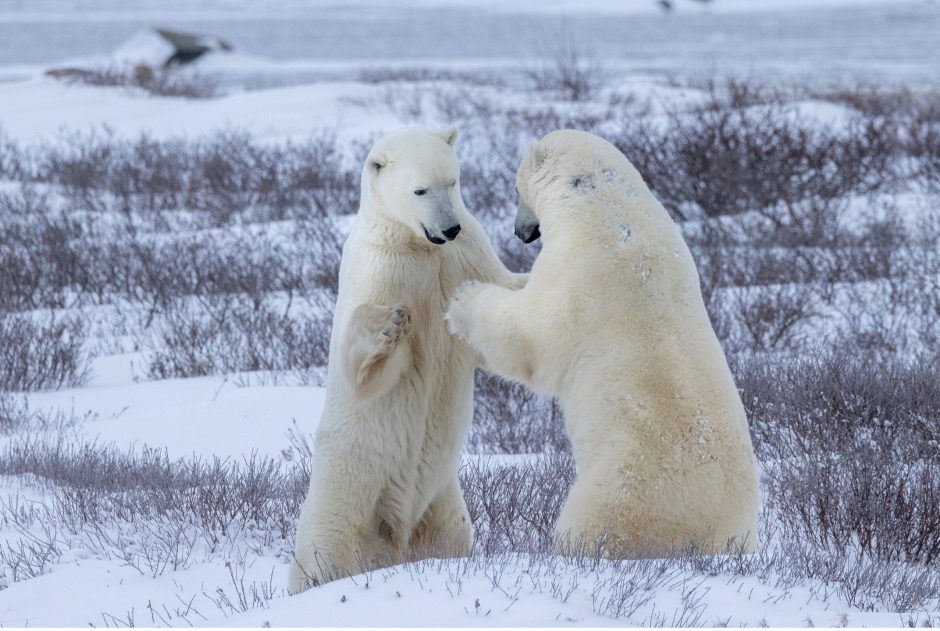
How to Get this Shot – Polar Bears Sparring
Capturing wildlife behaviors and action in your nature photography can be one of the most thrilling things to do with a camera (ok, so I’m a little biased). And when it comes to the biggest and most charismatic species in the world, it gets even more exciting and exhilarating!
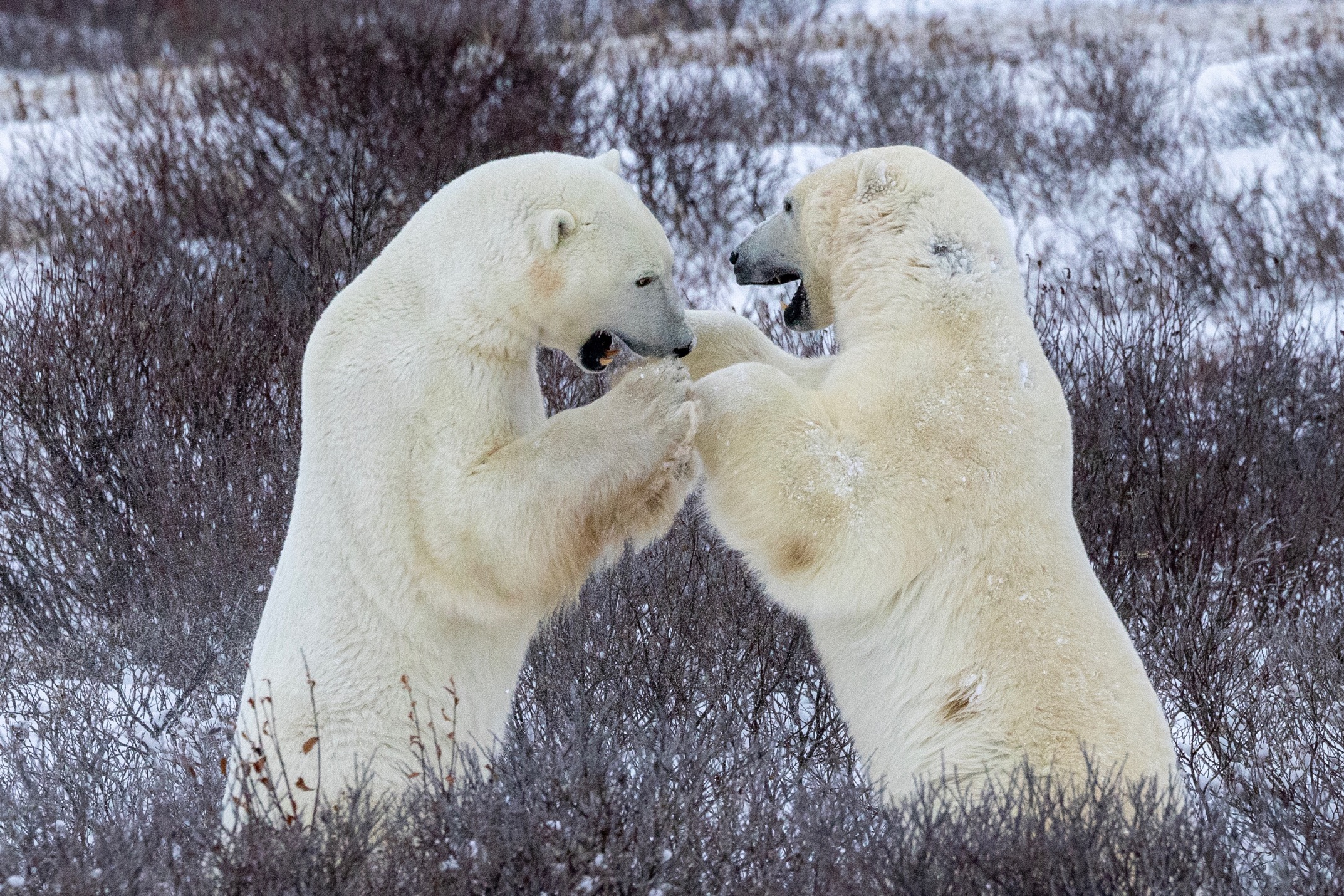
For most parts of the arctic, witnessing ‘play fighting’ amongst male polar bears is quite rare. However, in the conservation area outside of Churchill, Canada, the odds of seeing, and photographing this fascinating behavior increase dramatically. I will say, right out the gates, that this still isn’t an every trip or certainly every polar bear behavior, but in this dormant time in the Western Hudson Bay population of polar bears, this behavior is essential to their survival. They’re practicing and see how they stand against one another–in anticipation of when they’re playing for keeps…during winter and spring, and polar bear mating season.
To have a chance at capturing this mesmerizing display of strength and natural behavior, you’ll want to instantly know what to dial your camera to in order to capture the shot in crisp, spectacular ways.
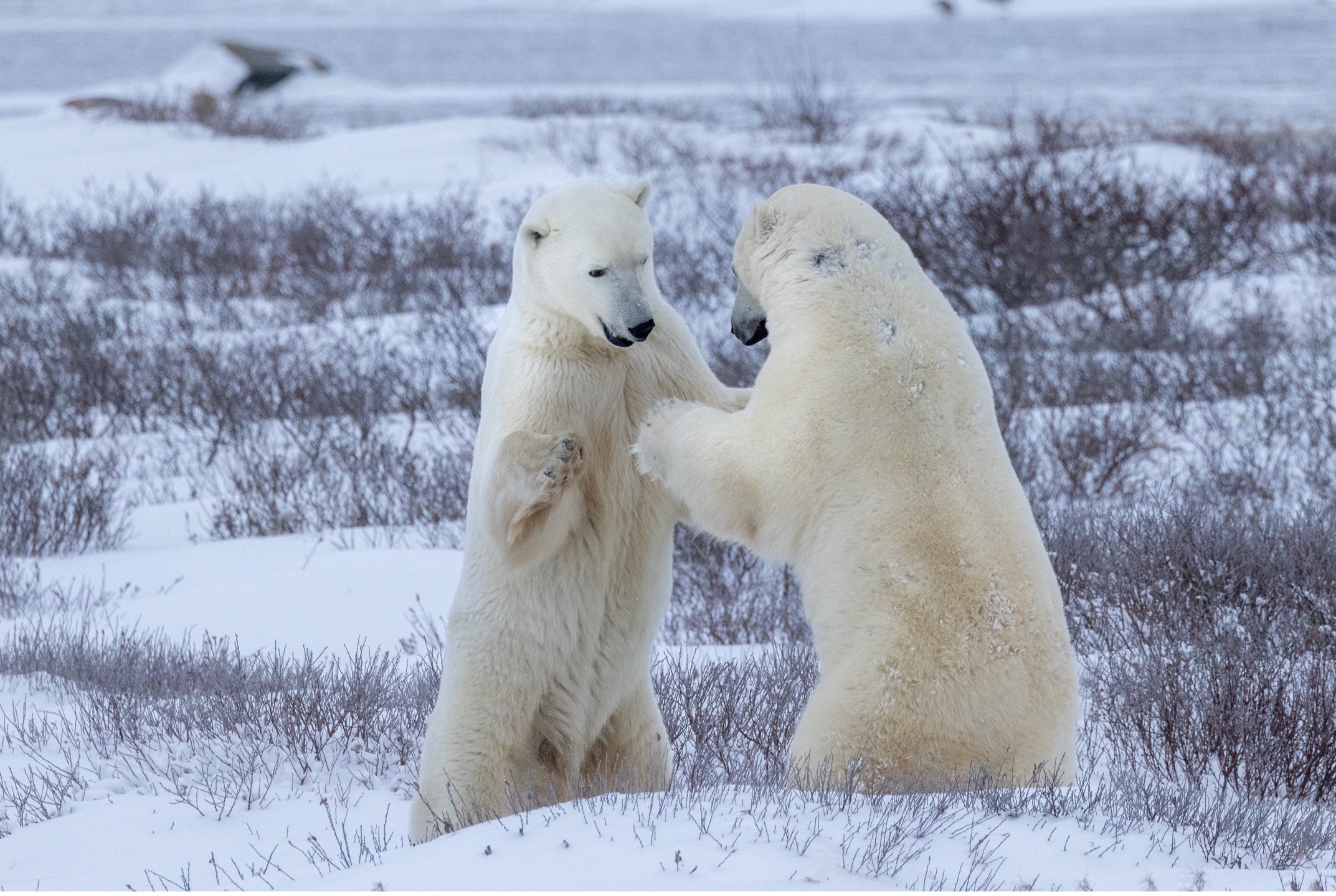
Start by Photographing Wide
The most common error I see when people begin photographing polar bear sparring is that they use all the telephoto/zoom they’ve got and fill the frame with the bears. It’s tempting–I get it. They have expressions and they are impressive, and you want to capture every detail in as big of way as possible. And this shot will come, but I advise ‘pulling back’ by shooting wider at the start.
What you’ll find is that the context of the shot begins to play out. You’ll have the tundra, the willows, maybe snow or fall colors (this can happen at any part of the season) and maybe even another rover. Yes, getting another Polar Rover in the photo can be a stunning ‘picture yourself here’ photo.
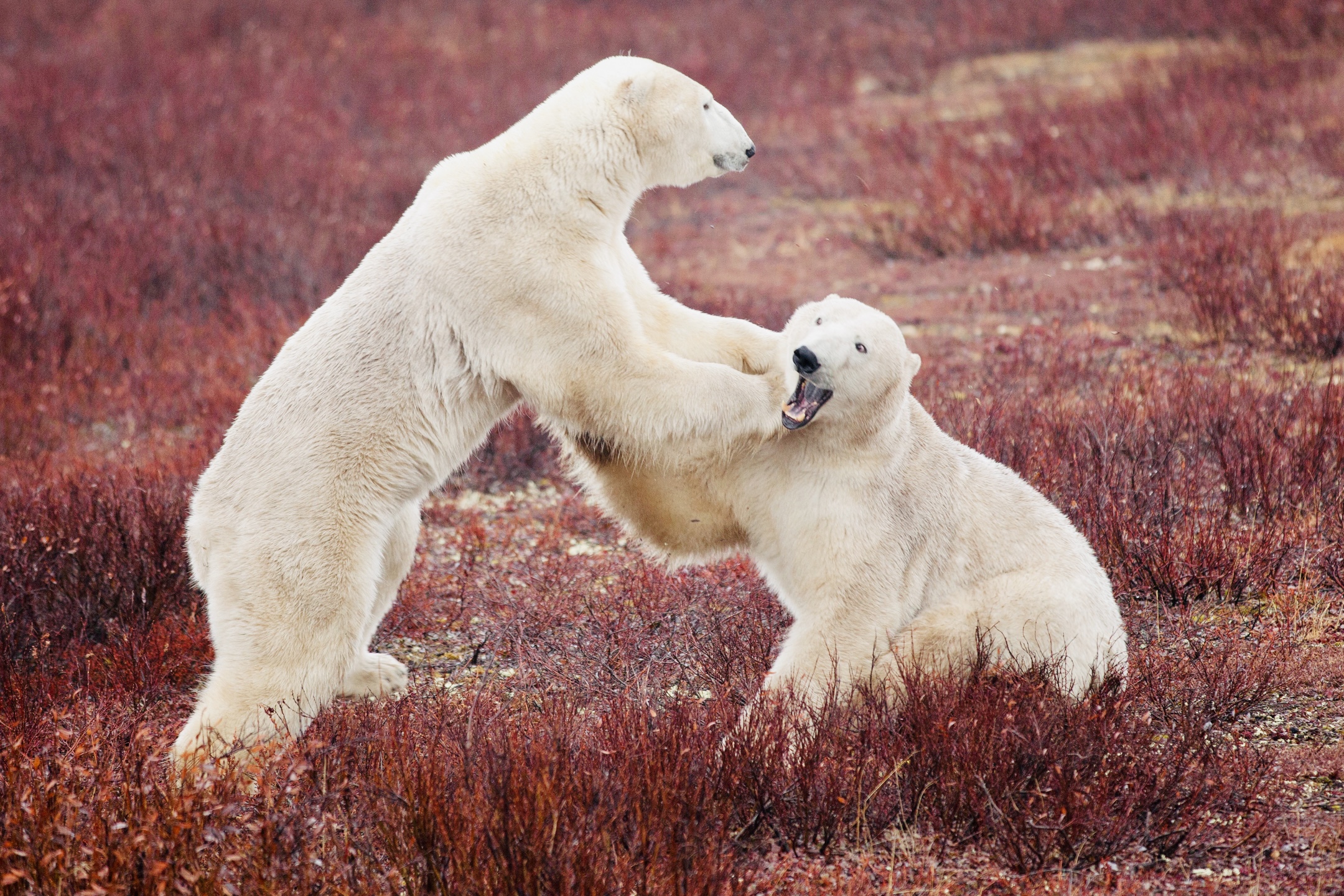
And the best part of all this is that it’s completely logical to shoot wider, as you approach the scene closer and closer. The filling-the-frame shots will come.
The point here is that make use of the distance, as you approach the area, to tell the whole story. Use traditional rules of composition for a few shots, then break them and take some creative shots when they’re square in the middle, or at a far corner or edge. This is a once in a lifetime opportunity, and your job is to photograph it in as many ways as possible in what is likely a short amount of time.
Settings for Success
With fast action you’ll need some specific settings. I always advise my guests to use Manual mode + Auto ISO. This way, you can dial in the shutter speed (important–we’ll get to this in a sec) and the maximum aperture to give you the look (and corresponding shutter speed and low ISO) that you want.
To, to cut to the chase, I put my f/number on the smallest it will go. Usually this is something like f/5.6 or f/6.3. However, if you have a lens that can go down to f/4, that’s great, but I wouldn’t recommend going lower than f/4 (e.g., f/2.8), because you do need the bears in focus…it’s simply the foreground and background that you can get a little blurred.
By ‘opening up’ your aperture to these small f/numbers, this lets light into your camera to allow you a rather fast shutter speed. For fast action like sparring bears, I recommend you be at least 1/1250th of a second, and 1/1600 is better. The exact speed depends on how fast the movement is, so if you are trying to capture a paw swinging across, you may even need to go faster. If they are ‘taking a break’ with minimal action, you can go a little slower.
The good thing is that you typically have ample light while photographing on the tundras of Churchill. Thus, with a relatively low f/number and such a fast shutter speed, your ISO shouldn’t be through the roof. However, you’ll want to monitor what your camera gives you (because, remember, it’s on auto) to make sure it’s within reason. But at the end of the day, you may have to deal with a high ISO to make sure that you get the shot…it’s just something you have to deal with (and you can always de-noise it slightly in post).
So to summarize, smallest f/number, shutter at ~1/1600, and Auto ISO.
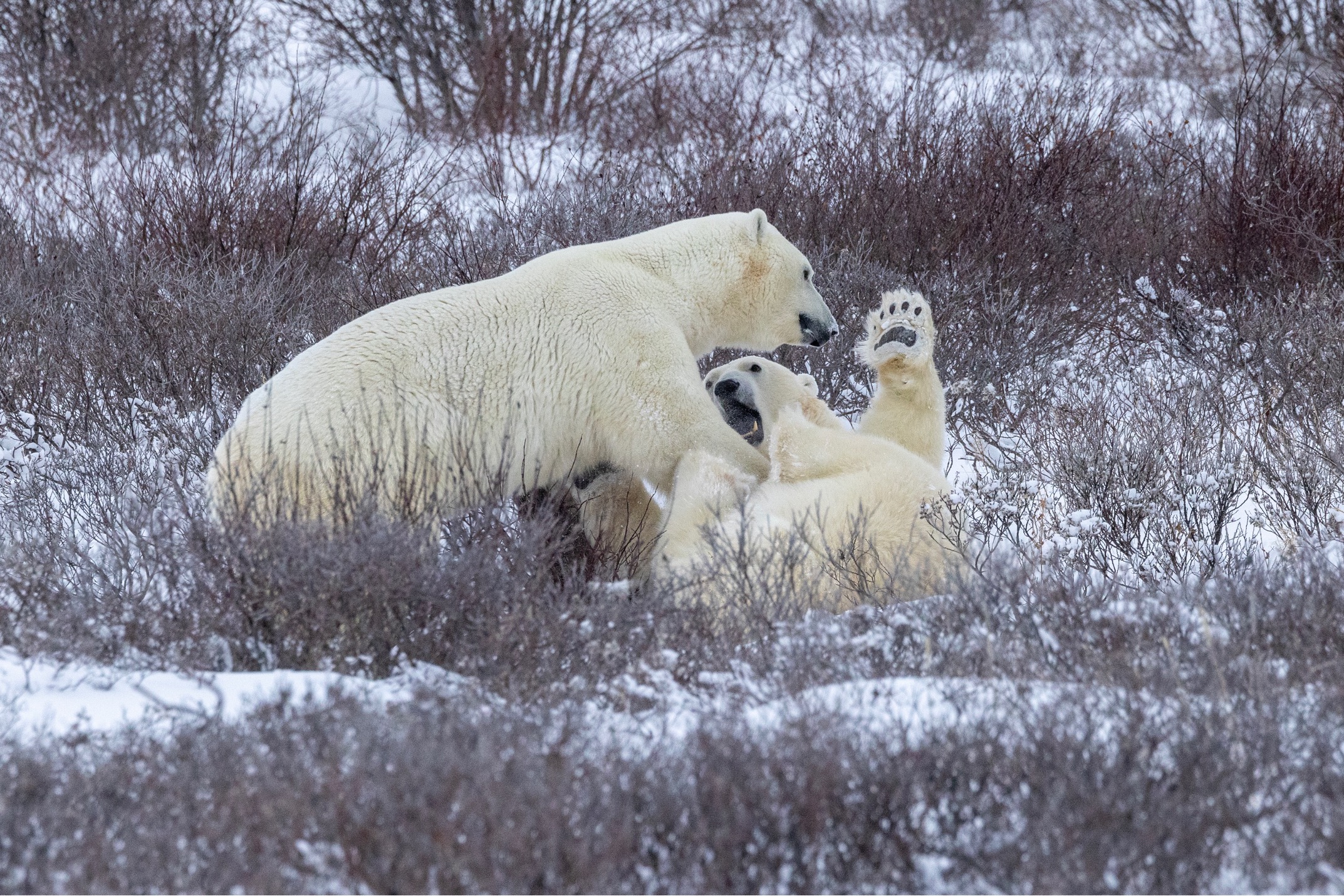
Burst Mode ON
This is critical. You want to be taking as many shots per second (aka frames-per-second, or FPS) as possible. Today, this might get you 20 or even 30+ photos per second. This is a good thing because there will be ONE photo to rule them all–I promise. There will be one photo where the expressions, the fur, the tilt of the heads, etc., is just better than the rest. And the more photos you take, the more options you have to pick the very best. You can delete extras later :).
When to Zoom In
This is rather subjective, as we all have our own taste in wildlife photography. I do tend to lean towards shooting wider–partly for the storytelling and partly so that I can crop and adjust composition afterwards. Because the motion and overall spontaneity of polar bears play fighting is so quick, I actually like to use my center-point-autofocus, put it on the eye of one of the bears, and keep them in the middle of the frame, knowing I might offset them to the side later by cropping. This way I am guaranteed focus on exactly what I want, and I can rapid fire a zillion photos without worrying about the accuracy of tracking autofocus (although I must admit, it does work, and continues to get better and better).
As a very loose rule of thumb, I want to hopefully get a few seconds (which translates to 60+ photos at 30 frames per second) of wide, a few seconds medium and a few seconds zoomed in as far as I can go. If the bears your viewing go for minutes or even longer, that’s fantastic, but if it only lasts for a minute or two, think wide-medium-tight.
Additional (Optional) Considerations
One thing I often advise, when conditions are snowy, is to increase your exposure compensation a tad. Not much, but by 1/3 or 2/3s of a stop. If you choose to keep it on even (zero), that’s fine, but you’ll likely find that the white bears on white background are more gray than you remember. This is your camera compensating for the overwhelming amount of white in the scene. However, the reality is that there actually is a lot of white in the scene, so you have to force your camera to acknowledge and express that with a touch of brightening.
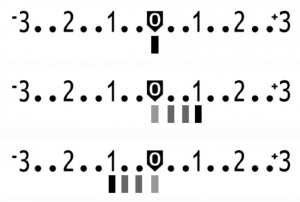
I should mention that this is quite easily fixed in Lightroom or Photoshop if you shoot on raw.
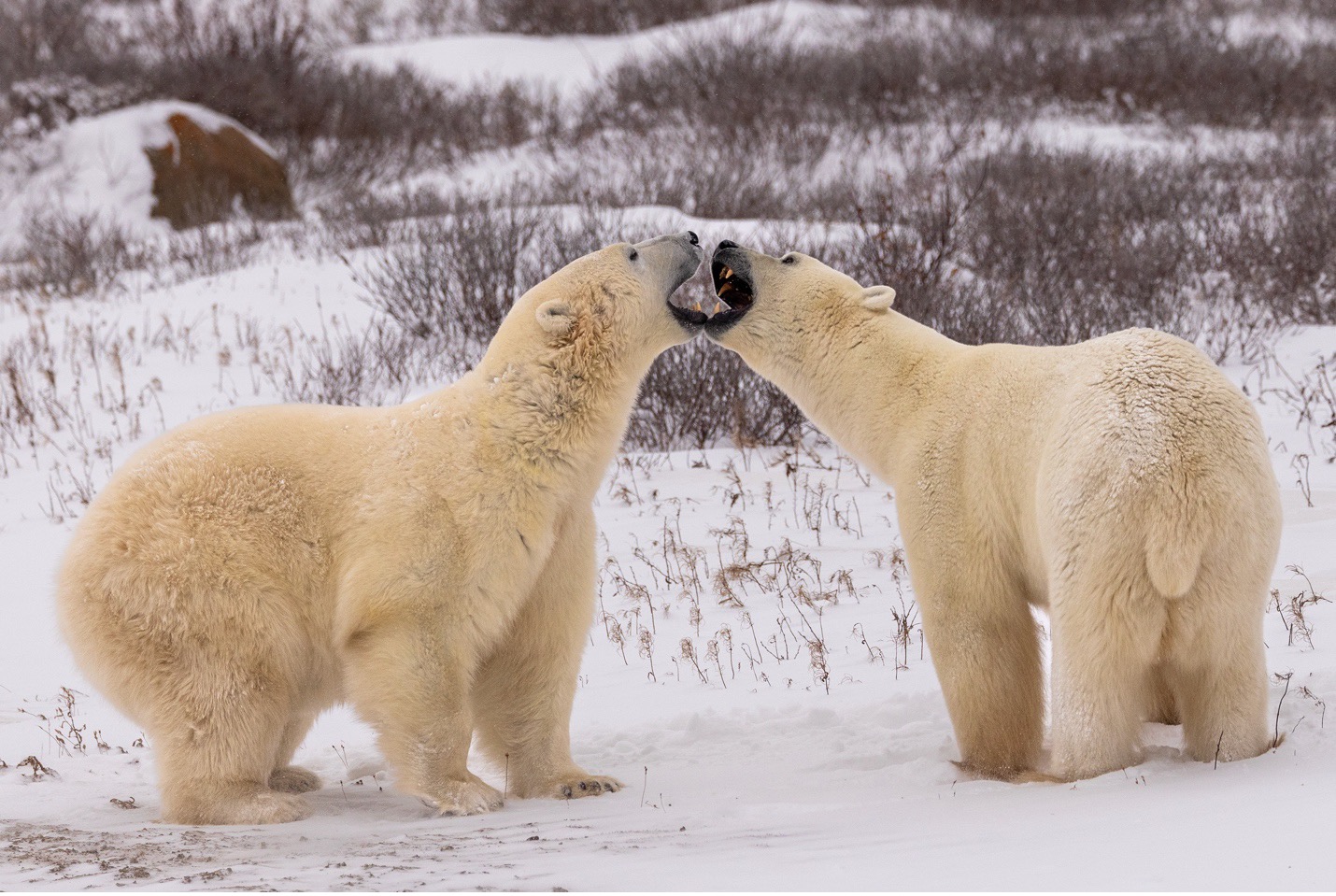
Same goes for white balance–although this is easily adjusted in Lightroom, I tend to shoot on ‘daylight’ settings for cool, blue arctic scenes. I find the colors are better represented and they are truly a bit more cool and cold looking–exactly what I want. Notice how in the below shot, compared to the others, there is a warmer (yellow) tint? It’s not necessarily bad, but you can compare this with the other photos in this article to see the color difference.
The final consideration, which is an important one, is that if you are filling the frame with the bears…edge-to-edge with the two bears, you may wish to consider bumping your aperture up to f/8 so that all of both bears is in focus. What you might find, if they take up the majority of the frame, is that a shallow depth of field like f/4 or maybe even f/5.6 just gives you too thin of a slice of focus to get the faces, shoulders, legs, and paws all in focus. This will cause you to take a hit on ISO, as f/8 lets in 50% of the light as f/5.6 (you can read more about this in our Aperture article), so don’t be indiscriminate on bumping your aperture up unless you really need it.
In Summary
If you are headed to Churchill for a polar bear photography adventure, you’re stacking the deck in your favor to see this incredible behavior. If you are fortunate, and have your camera ready, you’ll be treated to an extraordinary reward! Remember, shoot wide at first, then zoom in, trying to get a variety of shots in just a few seconds. Make sure to have your fastest frames-per-second dialed in, consider slightly overexposing the shot with a cool white balance (the blue end of the spectrum).
But then don’t forget, if time allows, to a) come up with your own creative settings to maximize variety and b) stop for a moment and truly enjoy the show.
Good luck out there!
Court
Leave a reply