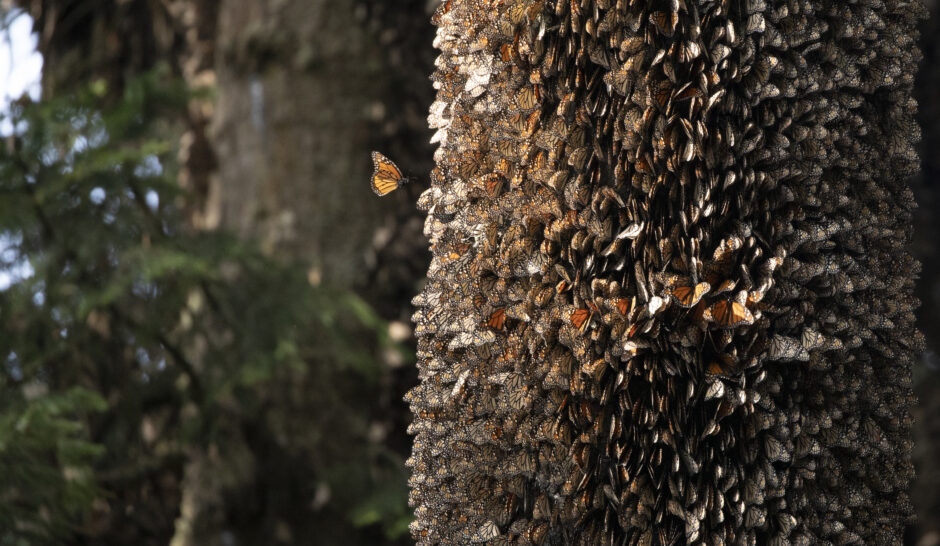
How to Get This Shot – A Monarch among Monarchs
This photo combines two of my favorite things to photograph on any Monarch Migration Photo Expedition. First, I love getting that “layered” look of monarchs absolutely covering a tree trunk. Second, I love photographing single monarchs in their grand colonies. It might sound strange to concentrate on the individuals when there are millions others around it, but there is something alluring, gentle, and captivating about solo monarchs, too. When you can combine these two together, you get some photo magic!
Read on to learn the simple yet very specific techniques needed to get a shot like this one in the Monarch Migration Biosphere Reserves of Mexico!
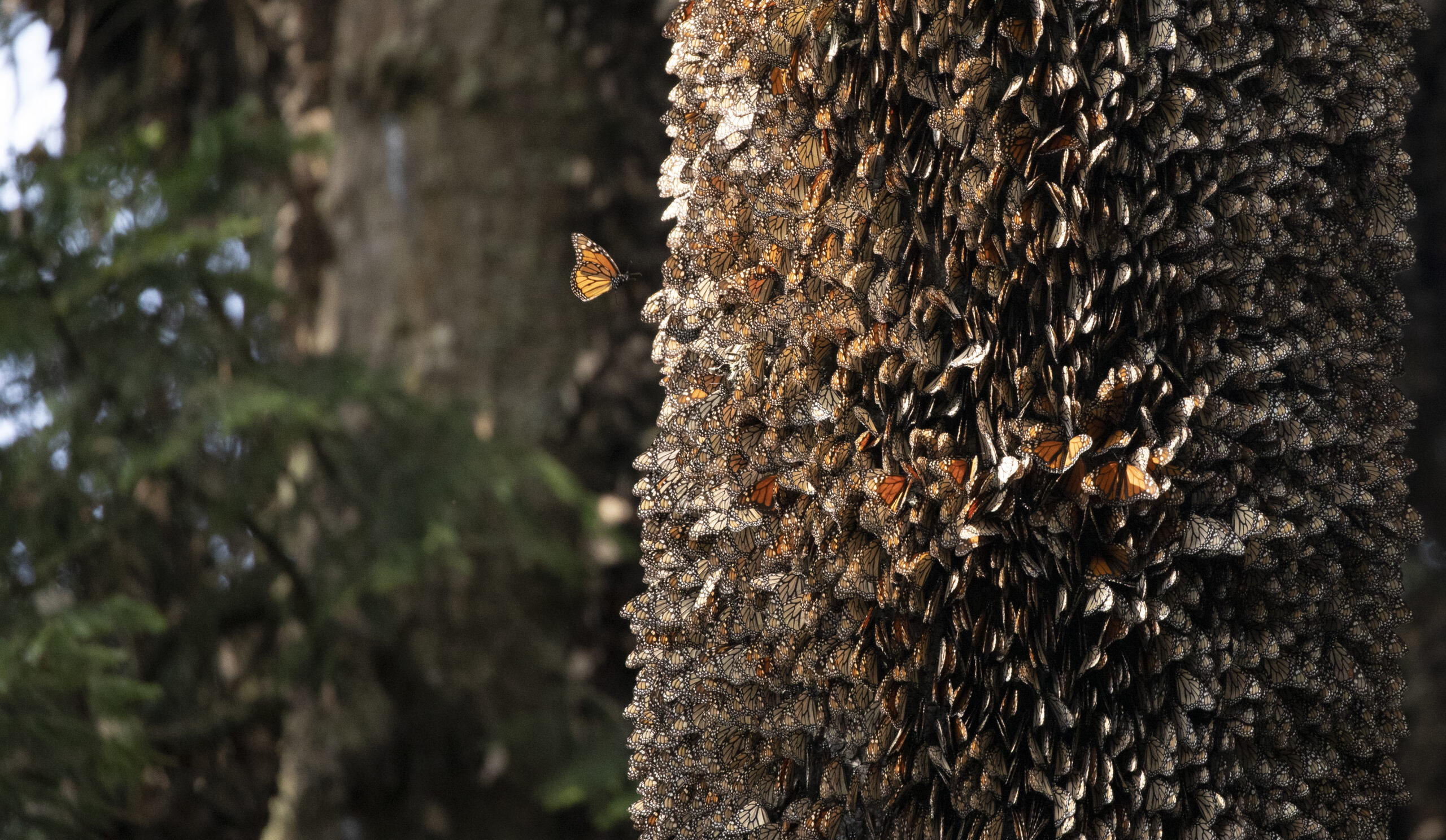
Ok, so I’ll admit it, some of this comes down to luck…it’s got to be that perfect moment. However, in the world of nature photography, we must create out own luck.
Finding the Right Tree
Although monarchs are virtually everywhere in these incredible overwintering colonies during the monarchs’ migration, there is a specific type of tree you need to look for.
First, you want to find a tree that is partially shaded and partially in the sun, giving you that lovely gradient of light. In addition to the sheer aesthetics of light, the sunlight is what creates activity among the monarchs. Without sun, they will be mostly sedentary and their wings closed…depriving us from that glorious orange and black upperside that is so iconic!
Next, you want to find a part of tree that allows you this view more-or-less at eye level. It doesn’t need to be perfectly at eye level, but we’re aiming for a few yards or meters above or below…not 30 feet higher or lower, as it will create an angle that is less than ideal.
A pro strategy here is to look for a tree where the light is just beginning to hit it at the side, and then wait. As the sun wraps around, activity will increase.
Camera Settings
Your aperture, shutter speed, and drive motor are quite important here.
First, you’ll want a deep depth of field, and thus a big f/number. I aim for something at least f/5.6, but truly f/8, f/9 or even f/11 can be best. To me, it helps to have all the monarchs in focus, and because they are filling the frame, you need to treat this scene as if it was a big landscape. You want the butterflies on the fringe and those directly in front, all in focus. While this may work with a smaller depth of field and smaller f/number, I advocate for playing it safe and then experimenting once you have at least one shot of just the tree with monarchs.
Second, you need to have a relatively fast shutter speed, as the sunlight causes the monarchs to quiver and/or take off and land over and over again. Thus, 1/800 would be my “slow” starting point, ramping up to 1/1250 or even 1/1600 if my light and ISO allow. Technically, you can’t shoot too fast. The faster the better, but you must keep an eye on your ISO, too. A fast shutter speed + big f/number + dense forest means light can be a limiting factor. If you find that f/11 and 1/1600 causes you to be at a prohibitively high ISO (e.g., 12,800), drop one or both down to my minimum suggested levels (e.g., f/5.6 and 1/800). Steadily increase your shutter speed until you are a comfortable ISO. But remember, at the end of the day, noise and high ISO can be somewhat fixed, a blurry monarch from motion blur cannot.
Remember, a “high ISO” is very subjective to your own tolerance as well as your camera’s ability. Thus, there is no one-size-fits-all here. Nevertheless, if you find your ISO going above 6400, start thinking about how to you can get more light into your camera…this might be finding a brighter tree, darkening your photos, or reducing your depth of field and shutter speed.
Finally, because it’s nearly impossible to take one single shot and expect to perfectly time something like this, I advocate that you set your camera to “burst mode.” Located under your “drive motor” settings, you want to maximize the number of photos taken per second so you can capture this split-second moment.
Your Lens
While you don’t need a super telephoto lens in all cases, the longer the reach the easier it is to find a suitable tree and get the shot. I typically like to have an available reach of 400 or 500mm, which is the equivalent of around a 10 to 15x zoom on a point and shoot camera.
The Moment
Much of this shot comes down to “the moment” that a butterfly is seen flitting about near one of these monarch-laden trees. Thus, it could happen quickly, or it could take some patience. Fortunately, when on a proper Monarch Migration Photo Expedition, you’ll have the time and guidance to stack the deck in your favor and create your own luck. It may not be every tree that affords you this opportunity, but when you do find such a tree, you need to be ready.
Beyond putting yourself in the right position and with the right camera settings, I like to save a step and autofocus on the monarchs and tree and then turn my camera to manual focus. This way, as long as you don’t bump your auto-focus ring, you can patiently wait for some activity and as “the moment” nears, you can simply raise your camera, fire away, and not lose precious seconds finding focus. By “locking in” your autofocus to what you plan to focus on (and not repositioning) your camera is ready to get the shot.
The rest is up to you, up to the monarchs’ behavior, and waiting for that glorious moment to put it all together.
In Summary
If you’re headed to witness the sensational monarch migration, this is only one of 100s of types of shots to look for. I’m continually amazed by how many ways we can photograph one species and one phenomenon.
If you’re keen to get a shot like this, simply stake out the right environmental settings, dial in your camera settings, and marvel at all around you as you wait for the magical moment to unfold.
Go forward and give it a shot!

Court

Leave a reply