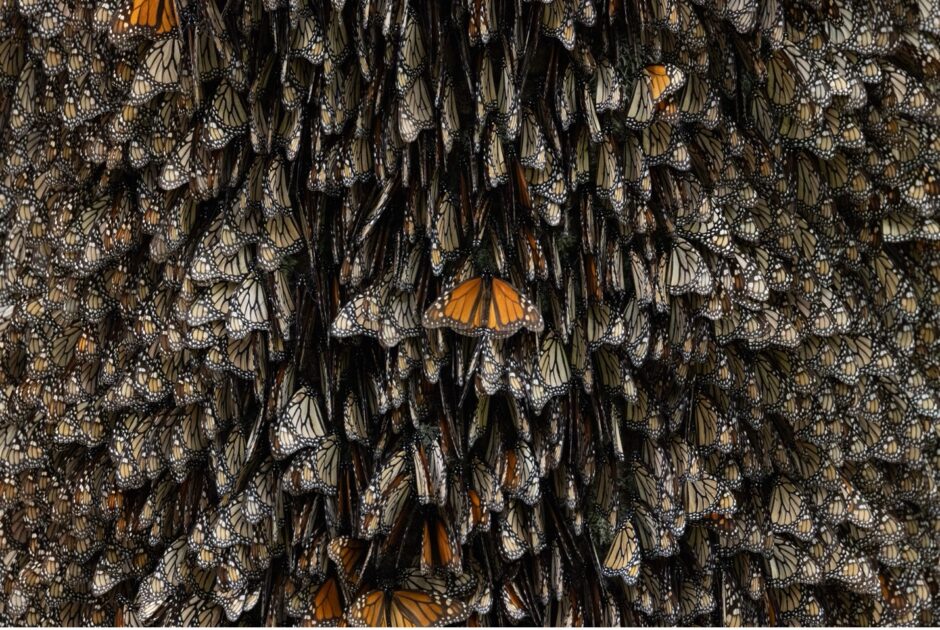
How to Get This Shot – Monarchs Edge to Edge
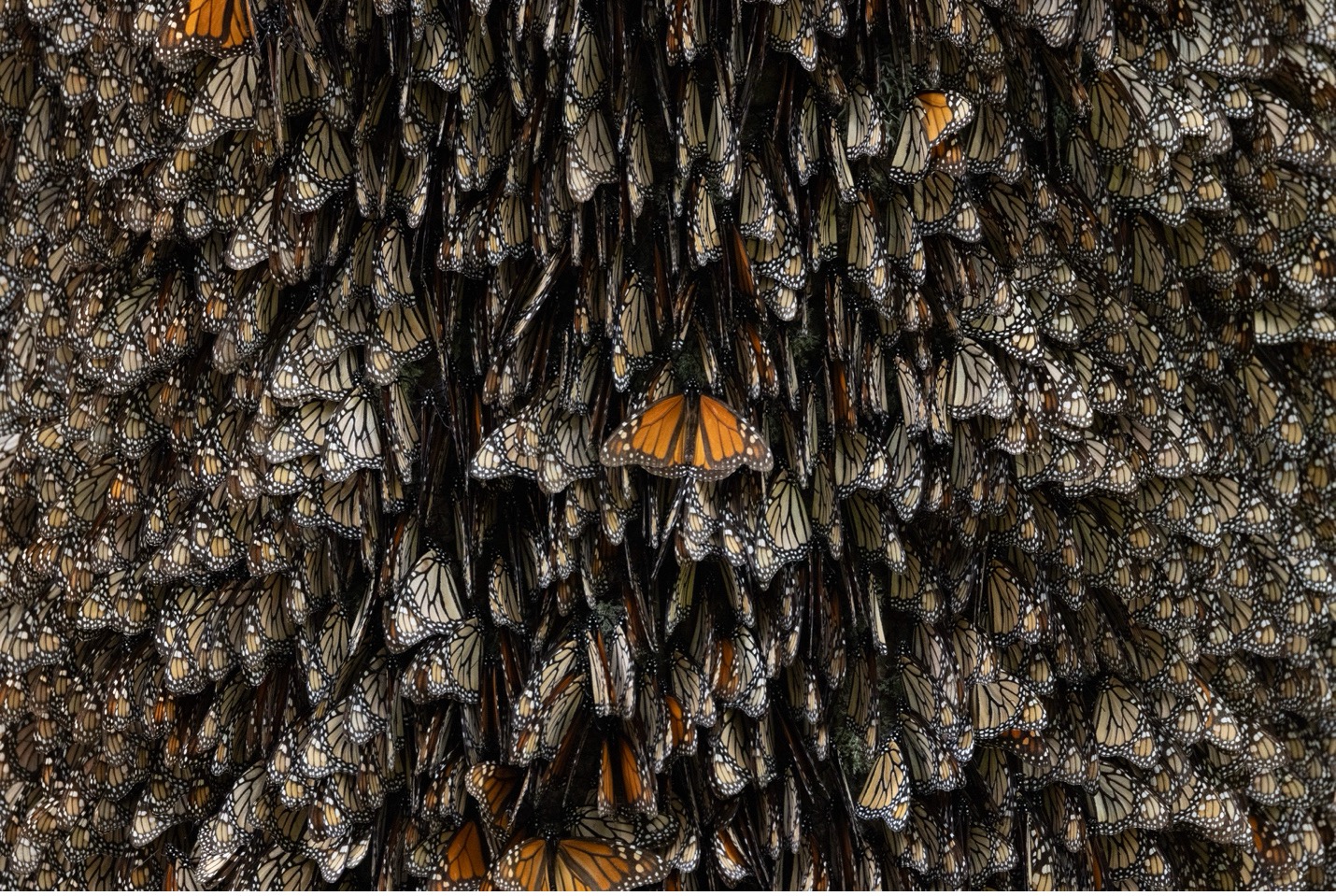
Getting a photo of migratory monarchs filling the frame like this is a coveted photo for any nature photographer lucky enough to embark on a monarch migration Photo Expedition. The trick here is a combination of finding the right part of the monarch colony, bringing the right gear, and choosing the right settings. In other words, it’s the whole shebang!
The Right Tree
If you are in the monarch sanctuaries of Mexico during the annual monarch overwintering event, you are likely to see many trees covered with monarchs. But you are looking for something specific.
First, you of course need to find the volume of monarchs. This is aided by joining a proper monarch photo tour, with guides that know the monarchs and the colonies inside and out. However, if you are on your own, don’t just look at the monarch clusters closest to you. You are really trying to find something that is a) evenly lit and b) relatively at eye level (I say relatively because plus or minus, say, 10 feet is fine, you just don’t want to be shooting up into the trees).
Because light can be quite mottled in the forest, this scene might be right in front of you, or it could be 40 yards away. Don’t settle for the closest monarchs…sometimes the best shots are out of sight for our eyes, but just fine for a camera with a telephoto lens.
The Right Gear
This brings me to another important point—a powerful telephoto is your friend here.
People often think that butterflies don’t need much zoom, because they’ll be all around you. Well, they will be, but again, it’s the small pockets of even lighting (ideally all shaded) and eye level butterfly clusters that produce a shot like this.
For me, my primary monarch lens is a 100-500mm, as it gives me the flexibility to zoom in and out, with a powerful maximum reach. These monarchs could be 50 yards away, but with the power in my lens, I can fill the frame—or at least fill it enough that some cropping will give me the desired effect.
The Right Settings
When photographing into the heart of the colony—or even just a small group of monarchs—it can be dark. I think having even lighting, preferably in the shade, and relying on ambient light provides the best results. It gives that gradient of light so you don’t get harsh highlights.
Another thing that you really need is a deep depth of field. Deeper than you might imagine, because you want the entire frame in focus. This might be f/8 or even more. Perhaps surprisingly, this is most akin to shooting a landscape photo, because you want the entire scene in focus.
Fortunately, the monarchs covering the trees aren’t very active (yet), so while you don’t need a super fast shutter (1/200 or 1/320 is usually a good starting point), you are faced with a) dim conditions and b) the need for a big f/number. Thus, I am used to needing higher ISOs of 1600 and maybe even higher.
While lower ISOs always yield better photos, this is just how it is. A tripod might help a little, but in the slopes of the monarch reserves, tripods can be challenging and cumbersome. Bring one if you’re an ardent tripod user, but I wouldn’t rely on it as a saving grace.
The Right Moment
What adds extra umph to this shot is the lone monarch opening its wings. Part of the trick here is finding monarchs in the shade that are just starting to move around. Going on an itinerary that puts you in reserves at different times of day is a big plus, but also just looking around with keen eyes is going to be quite impactful for the overall result.
Oftentimes a single monarch will begin slightly moving, and that flash of orange is going to be your cue. They need to move a bit to warm their flight muscles, so you usually have some time before they all start moving (likely a few minutes) but once you see this, you will want to act quickly.
A way to improve your odds is to shoot multiple photos at once using burst mode. Typically the monarchs won’t be moving fast, so again, you can stick with a moderate shutter speed, but taking, say, eight to ten photos a second will increase your chances of getting that moment when the wings are open and glorious.
If you’re interested in more techniques for monarch butterfly photography, check out my full tutorial video, shot in Mexico’s monarch sanctuaries, below:
Photographing Mexico’s Monarch Migration
As you can see, there’s a lot going on here to get the shot. You need to be in the right place, and that will take some trial and error. Fortunately, on a monarch butterfly Photo Expedition you’ll have the time.
You also need to think about your gear. My advice? Stick with the tried and true zoom telephoto class of lenses that get you at least 400mm. Honestly, the more telephoto the better.
You’ll also want to shoot this like a landscape shot, with a deep depth of field, paying attention to shutter speed primarily as a way to minimize hand movement effects. As with all wildlife and nature photography, these settings need to be played with and adjusted based on the conditions. A little faster or slower with shutter, a little shallower or deeper with depth of field…
If you are headed down to the monarch colonies of Central Mexico, I wish you a sensational time. It’s a life-changing trip for many nature travelers, and I hope you enjoy it—and capture it—in the best ways possible!
All the best,

Court

Leave a reply