How to Get This Shot: The World’s Smallest Owl
There are few things in bird photography more humbling than spending hours hiking through the Arizona heat looking for a bird roughly the size of an angry potato.
Enter the elf owl.
The world’s smallest owl. A bird so tiny and absurdly camouflaged that photographing one feels less like wildlife photography and more like participating in an elaborate scavenger hunt designed by a very sadistic park ranger.
I photographed this little goblin in the Chiricahua Mountains of southeastern Arizona while photographing for an Earthwatch Expedition studying owls of the American Southwest. The Chiricahuas are one of those wonderfully strange places where desert, oak woodland, and volcanic mountains all crash into each other and create a ridiculous amount of biodiversity. Great for birds. Slightly overwhelming for photographers.
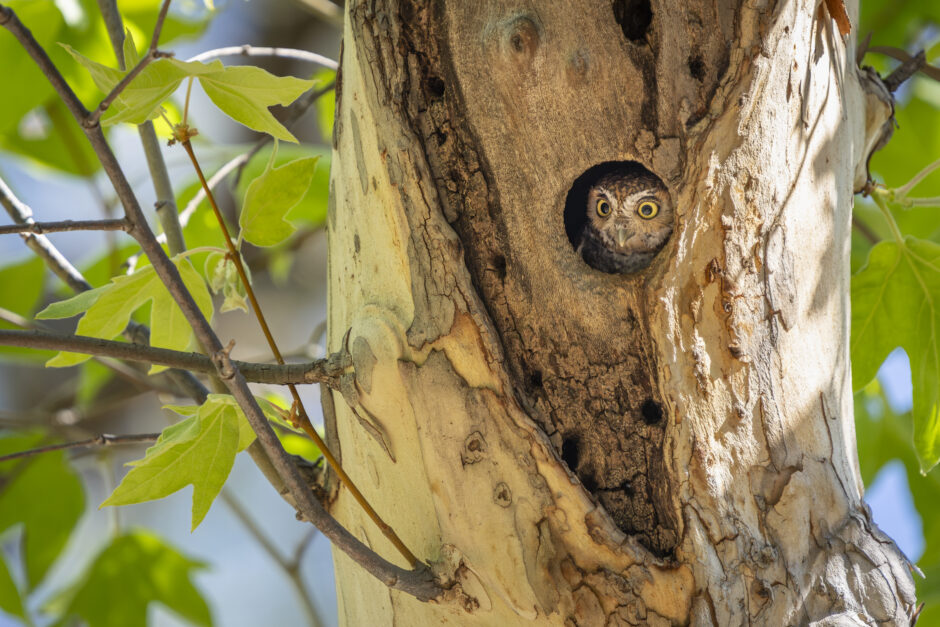
This owl was tucked into a cavity in a sunlit tree, peeking out just enough to keep tabs on the world outside. At first glance, the image feels simple. Owl. Hole. Nice light. Done.
Yeah, not exactly.
Photographing small owls in busy habitat is basically visual warfare. Leaves everywhere. Branches everywhere. Spots of harsh Arizona sunlight punching through the canopy like celestial interrogation lamps. Meanwhile your subject is trying very hard to resemble bark with eyeballs.
Most photographers see this and immediately start doing the nervous side-to-side shuffle trying to force a cleaner angle. But with nesting birds, especially owls, restraint matters more than creativity.
So instead, I stayed put.
The cavity itself was part of the story anyway. I didn’t want just a floating owl face with buttery background blur that could’ve been photographed anywhere. I wanted the texture of the bark, the bright green leaves, and the tiny scale of the entrance hole to emphasize just how absurdly small these owls are. The owl’s giant yellow eyes do the rest.
Camera Settings
- ISO: 800
- Focal Length: 600mm
- Aperture: f/6.3
- Shutter Speed: 1/800 sec
The 600mm focal length was essential for two reasons. First, composition. It let me create an intimate portrait while still including enough of the environment to tell the story. Second, ethics. Long lenses are not just artistic tools. They’re ethical tools. Especially around nests. The farther I can stay from the bird while still making a strong image, the better. Owls don’t need a photographer standing under the nest cavity breathing heavily and “connecting with nature.”
I used f/6.3 to soften the chaos of the habitat while keeping the owl sharp. Too much depth of field and suddenly every branch, leaf, and bark texture starts competing for attention like drunk wedding guests fighting over the microphone.
At 600mm, tiny movements become amplified fast, so 1/800 sec gave me enough shutter speed to keep the eyes sharp. Owls may look still, but their heads twitch constantly as they monitor movement around the nest.
ISO 800 ended up being the compromise because the lighting was classic Arizona woodland nonsense. The owl sat deep in shade while the surrounding bark and leaves were catching direct sunlight bright enough to melt optimism. Raising the ISO gave me enough shutter speed without underexposing the owl’s face.
The key moment came when the owl leaned just slightly forward into reflected light bouncing around the cavity entrance. That tiny shift brought life into the eyes. Without catchlight, owl portraits can feel flat fast. With it, suddenly there’s personality. Tiny feathery judgment.
And this owl absolutely looked like it was judging me.
An Important Note About Photographing Owl Nests
Let’s talk about the part social media usually skips. Photographing nesting owls comes with real responsibility. If your photo exists because the bird was stressed, displaced, or repeatedly disturbed, then it’s not a successful wildlife image no matter how sharp it is. When photographing owl nests, I follow a few hard rules:
- Keep significant distance
- Use a long lens
- Limit time at the site
- Avoid repeated visits
- Never block their entrance or exit
And if the owl changes behavior because of my presence, I back off immediately. Also, don’t publicly share exact nest locations. One respectful photographer can quickly turn into twenty less respectful photographers once GPS pins hit the internet. Ironically, restraint usually creates better images anyway. Calm birds behave naturally. Natural behavior creates honest photographs.
One of the best parts of joining the Earthwatch expedition, Arizona’s Forest Owls is the chance to photograph species like the elf owl ethically and responsibly alongside real researchers in Arizona’s Chiricahua Mountains. Instead of stressing wildlife for a photo, participants learn how to observe owl behavior carefully while collecting meaningful data in one of the most biodiverse birding regions in the country. Plus, spending evenings searching for tiny owls in the desert mountains beats answering emails at home by a wide margin.
This elf owl gave me a few brief looks from the cavity before disappearing back into the darkness of the tree. That was enough. Honestly, more than enough.
Happy Photographing,


Leave a reply