
Tips on Packing Photo Gear for African Safaris
Bringing the camera gear you want and need for an African safari is a critical step in any photographer’s pre-trip phase. How to pack, what to choose, and how that all translates to day-to-day toting around are truly vital considerations for a successful photo trip.
This article aims to tackle this from personal advice as well as industry best-practices from decades of safari travel, as well as gleaning much from fellow Photo Expedition Leaders and pro photographers from around the world.
If you are looking for more general advice on exactly what to pack, consider reading this article here on What Gear to Pack for a Botswana Photo Expedition or a video version below!
The rest of this article will specifically be about how to pack and protect your gear.
Don’t Baby Your Gear Too Much
I know, this is a loaded statement. I don’t mean that you can crash your camera bag around and have loose lenses on their own free will inside your bag. I’ll get to my strategies in a second, but a good overarching statement is that you really don’t have to go overboard in protecting to ensure that your lenses aren’t dinged, damaged, or harmed in truly any way.
Modern cameras and lenses are relatively tough, and while they do require some protection and proper packing to endure the rigors of international travel, it’s easy to treat them like fabrige eggs, and that’s simply not necessary.
Plus, the better your camera gear (and your own increased desire to protect it), the more durable they are.
Pad and Limit Movement
The number one bit of advice is to keep your lenses from jiggling around in your camera bag of choice. Whether you pack them into a proper camera bag, a roller bag, or simply a daypack, my main priority is to pad them with whatever I’ve got to essentially “lock” them into place.
The biggest potential for damage or issues is if your lens, camera, or accessories are moving around in your bag—rubbing against each other, buckles, zippers, or even just perpetually rubbing against Velcro. Minor damage, but indeed a risk.
While I do travel with a proper camera bag (I use the Shimoda Designs Action X 40 most of the time) that has compartments to slot my lenses and camera bodies in, I still take extra tshirts, socks, or anything soft and malleable and make sure that there is limited movement once the bag is packed and zipped up.
Just think, if you are walking 10,000 steps a day in and out of airports on your long journey to Africa, each step has the potential to jostle loose lenses and accessories. Pack your bag tight and full—that’s the single best approach here.
For this reason, try and choose a camera bag that fits your gear…having too much room is actually a bad thing. But, if you find yourself in that predicament, pack some of your clothes in your camera bag to eliminate the dead space.
Remember, pack it tight.
What to Do with Big Prime Lenses
The decision of whether or not to bring your bazooka lens is totally up to you. Chances are if you have one, you’re going to want to bring it. They are remarkable lenses, excellent for low light and wildlife, but usually take up nearly half your camera bag.
The above still applies, in terms of packing things securely so they don’t jostle, but one thing I often consider with big primes is to remove and pack the lens hood separately. These hoods (specifically on big prime lenses, like 400mm f/2.8 or 600mm f/4) are often nearly as big as the prime lens themselves, and they don’t have the most secure attachment. In other words, even with padding, slight jostling could damage the attachment mechanism, such that a) you’ve got damaged gear and b) you potentially have a loose, large piece of gear that could move around in your bag and damage other things.
I find that the lens hood is probably the least valuable part of the prime lens setup, and I’m ok packing it in my “checked bag.” Because of the shape, I can usually fold some pants or a rain jacket to go inside of the lenshood and thus it really doesn’t take up much space.
As with all camera gear, I still try and pad the heck out of my checked bag so that things aren’t moving around. While small scratches aren’t going to do anything bad for your photography, it can hamper re-sale value, so I still try and protect it reasonably.
Just a note…this lenshood suggestion really only applies to big prime telephoto lenses where the lens hood is wildly large. I don’t bother with this for any other types of lenses, including my 100-500, 70-200, 24-105, etc.
Do Not Keep your Lenses Attached to your Camera Body
This is another very important one. While it might be convenient and save space during travel days, the coupling mechanism between your lens and camera is likely the most fragile aspect of your entire setup. Truly the only times I’ve ever heard of camera gear damage when traveling is when someone forgot to decouple their lens from their body, and a jostle (and resulting torque) from the large lens snaps this coupling mechanism right off. This seriously damages both your lens and body, and it’s about the worst thing that can happen. It’s shame that it’s also one of the easiest things to happen, too.
Thus, always remember to decouple. I now do this for all lenses, even my 24-105, as I just don’t want to risk it.
Translating this to Day-to-Day Travel while on Safari
I’ve found over the years that the bag configuration I want and need for big travel days is different than what I want when I’m in a safari vehicle or on a hike, prepared for photo opportunities at any moment.
Because I use a camera bag with those little Velcro panels, which create compartments for different-sized gear, I now bring a few extra panels in my bag so that on night 1, after I’ve gotten through all the big international travel and only have smaller planes or drives ahead of me, I reorganize and “reshape” my camera bag.
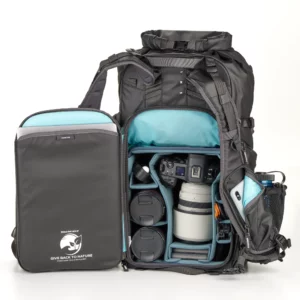
Far be it from me to tell you exactly how you like to organize your gear, but reshaping allows me to maximize protection and even up my weight (so that my bag isn’t lopsided for long walks through airports), at the expense of having certain gear more readily available.
However, when I’m on the ground on, say, a Botswana Photo Expedition, I want everything very accessible so that I can open my bag in the first moments of a game drive and be ready for action.
Keeping Gear Safe During the Safari
As you may have gleaned, I’m FAR less worried about my camera gear protection while on-the-ground and once the safari has begun. I’m still cautious about travel days, where small bush flights may take place, but I suppose it’s a tiered system of thought, like the below:
- International travel: most protection, extra padding, zero internal movement in my bag, all at the expense of lack of accessibility.
- In-country travel (e.g., long drives or bush flights): reasonable protection, some padding, but more accessibility at the expense of maximum protection (this is where a dedicated camera bag works wonders, as it has inherent protection built in, compare to, say, a daypack without internal panels or compartments). I usually have one camera out with me, whether it’s a drive or a flight, so a) I have some of my gear in my hands for protection and b) there is more space such that I need to fill and pad with extra stuff.
- Safari drives: maximize accessibility and be able to deploy my camera within seconds. I still minimize jostling and definitely don’t want batteries flying around inside my pack as I swing my bag into the safari vehicle, but the key thing is accessibility. I usually have my cameras out and ready and not even inside the bag, so protection is less necessary.
For any of the above scenarios, when someone else is handling my bag, I really strive to disconnect lenses from bodies.

One lingering question might still be in your mind, which is how do I ensure that my camera gears makes it on the plane with me each and every time during international flights and connections. You know the issue…the flight is full, and they ask for volunteers for giving up your bag to put down below…and you start wondering what your airline status is and how you’ll go about insisting that it can’t go into the bottom of the plane.
Well, my strategy is simple, and for the sake of organization, I’ll bullet list it below:
- Be polite and super nice, always. This above all else.
- When selecting your bag, think about the optics. Does your current bag make you look like a ninja turtle with a massive, massive shell? Newer bags provide the same space and protection, but are slimmer and more form fitting. Black bags “look” smaller…remember, it’s about optics. Tuck straps in, use the compression straps if you have them and just make your whole kit look streamlines, sleek, and small. Things dangling off, weird bulges at the top of your bag that make it look cumbersome will draw attention.
- Explain that you have professional camera gear with you that is super fragile and it simple cannot go below.
- If that still doesn’t work, explain that most of what is in that bag is lithium batteries due to your robust camera setup and those simply can’t go below…they’ll get it.
In Summary
The long-haul travel segment of any safari is usually one of the most daunting aspects of the trip. There are a lot of unknowns and you give up a lot of control when relying on airlines. However, through these simple tricks, repeated over and over again, you’ll gain the confidence I have knowing your camera gear will be safe.
Remember, think tight and no jostling. Remove lenses from camera bodies. And, don’t think you need to pack and configure your bag for travel says as if you’re going to be taking photos any moment…that time will come and plan to reconfigure your bag once on-the-ground.
If you’re headed on a safari to Africa, whether it’s iconic Botswana, famed East Africa, or something else, I wish you the most amazing time and I hope this advice helps!
Enjoy it out there,
Court

Leave a reply