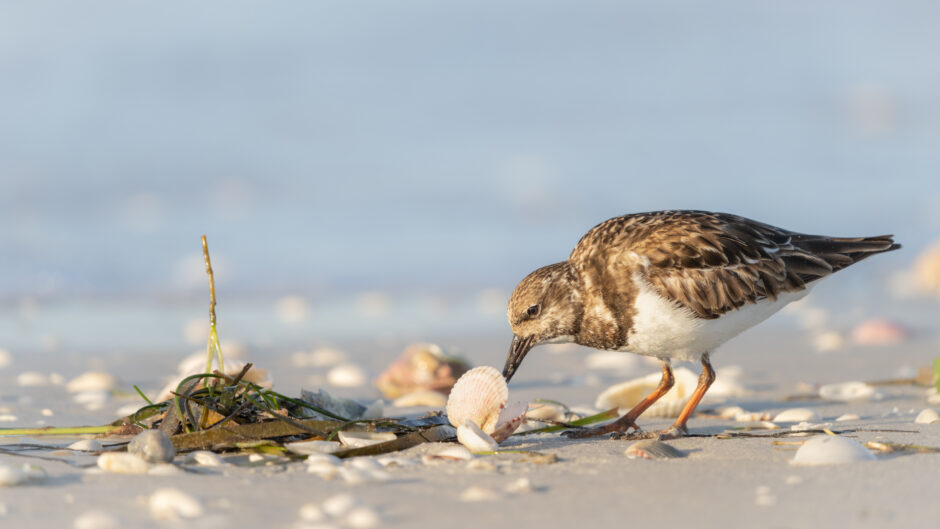
Shot Settings: Shorebird on the Shore
There is something deeply satisfying about photographing shorebirds. No dramatic mountain backdrop. No epic predator-prey interaction. Just a small bird, busy at work, doing what it has done for thousands of years along the tideline in the Galapagos. In this case, a Ruddy Turnstone methodically flipping shells and bits of seaweed in search of a meal.
Here are the exact settings for this image:
- ISO: 200
- Focal Length: 600mm
- Aperture: f/6.3
- Shutter Speed: 1/640 sec
And more importantly, here is why they worked.
Shutter Speed: 1/640 sec
Feeding shorebirds rarely stop moving. They take a few quick steps, jab at something in the sand, pause for half a second, then repeat. Even when they appear calm, there is constant head movement.
1/640 sec is a sweet spot for this type of behavior. It is fast enough to freeze subtle head motion and quick pecks into the sand, yet not so fast that you are forced into a high ISO unnecessarily. Could you go faster? Sure. If the bird is actively flipping shells or competing with other birds, bumping up to 1/1000 sec gives you a little more insurance. But for a single bird calmly feeding in good light, 1/640 sec keeps things sharp without sacrificing image quality.
One tip in the field: watch the rhythm of the bird. Ruddy Turnstones tend to move in short bursts. Track the bird through the viewfinder and fire a short burst right as it pauses to inspect or grab something. That half-second of stillness is your sharpest frame.
Aperture: f/6.3
At 600mm, depth of field is razor thin. Even at f/6.3, you are working with very limited focus depth, especially at close range. So why not stop down to f/8 or f/11? Because separation matters.
The beach environment can get messy fast. Shell fragments, seaweed, foam, footprints. By shooting at f/6.3, the background melts into soft color and texture, isolating the bird from the clutter. The subject pops, and the viewer’s eye goes straight to the turnstone. The key is making sure the eye is tack sharp. With long lenses and shallow depth of field, if you miss focus by even a fraction, the image falls apart. Use a single-point autofocus and place it directly on the eye. Not the chest. Not the wing. The eye.
If the bird is angled slightly toward you, as in this frame, you gain just enough depth of field to keep the face and some of the body sharp while still maintaining that soft beach backdrop.
Focal Length: 600mm
Shorebirds are small. Even relatively approachable species like Ruddy Turnstones benefit from reach. At 600mm, you can fill the frame without pushing the bird. This is critical. The moment you crowd a feeding shorebird, it either flies or starts giving you nervous behavior. Neither results in relaxed, natural images.
A long lens also compresses the background, turning distant surf and sand into smooth washes of color. That compression helps simplify the composition and eliminate distractions.
One important field technique here: get low. And I mean really low.
- Lie in the sand if you have to. When you drop to eye level, three things happen:
- The background becomes distant and soft instead of busy and chaotic.
- The bird appears more intimate and powerful.
- You enter the bird’s world rather than looking down on it.
This perspective shift is often the difference between a snapshot and a compelling portrait.
ISO: 200
Bright beach light is a gift. Use it. At ISO 200, you maintain excellent image quality with minimal noise and strong dynamic range. Beaches can be tricky because light sand reflects a lot of brightness, potentially fooling your meter. Always check your histogram. White shells and pale sand can blow out quickly. Slightly underexposing by a third of a stop can help preserve detail in highlights, especially on white plumage.
The Ruddy Turnstone has a mix of browns, blacks and whites. Preserving detail in those lighter feathers is important. You can always lift shadows in post, but blown highlights are gone for good.
Composition and Behavior
What makes this frame work is not just the technical settings. It is the behavior.
The bird is engaged with its environment, investigating a shell among scattered beach debris. The shell and seaweed add context without overwhelming the subject. They tell a story about what the bird is doing.
When photographing feeding behavior, resist the urge to always wait for a perfectly clean background. A bit of habitat creates narrative. The key is balance. Too much clutter distracts. Just enough anchors the subject in its real world.
Watch for moments when the bird interacts with something tangible. A lifted shell. A droplet of water. A strand of seaweed. Those micro-interactions elevate the image from a portrait to a story.
Field Techniques for Shorebirds
A few quick tips for your next beach session:
- Move slowly and predictably. Sudden movements send birds airborne.
- Approach at an angle rather than directly head-on.
- Sit or lie down and let the birds come back to you.
- Shoot in short bursts when the head is still and the eye is visible.
- Pay attention to the direction of light. Side light reveals feather texture beautifully.
Shorebirds reward patience. If you stay low and calm for 15 or 20 minutes, you will often find them resuming natural behavior around you.
Parting Words
Photographing a shorebird feeding is not about dramatic action. It is about subtlety, patience and clean technique. A moderate shutter speed to freeze motion. A wide enough aperture to isolate the subject. A long lens to maintain respectful distance. A low perspective to create intimacy.
Small coastal birds are found across much of the world, and they offer fantastic practice for refining your wildlife technique.
On our Galapagos Wildlife Photo Expedition, we often spend dedicated time working with shorebirds like this, refining fieldcraft and dialing in settings in dynamic beach environments. It is one of the best classrooms a wildlife photographer could ask for. Wind, light, moving subjects and endless opportunities to improve.
Now all you need is a quiet stretch of sand and a bird willing to turn a few stones.
Happy Photographing,


Leave a reply