How to Get This Shot: Moran Above the Clouds
Some mornings in Grand Teton National Park give you a pretty sunrise. Others apparently decide subtlety is overrated and float an entire mountain above a sea of clouds.
This was one of those mornings.
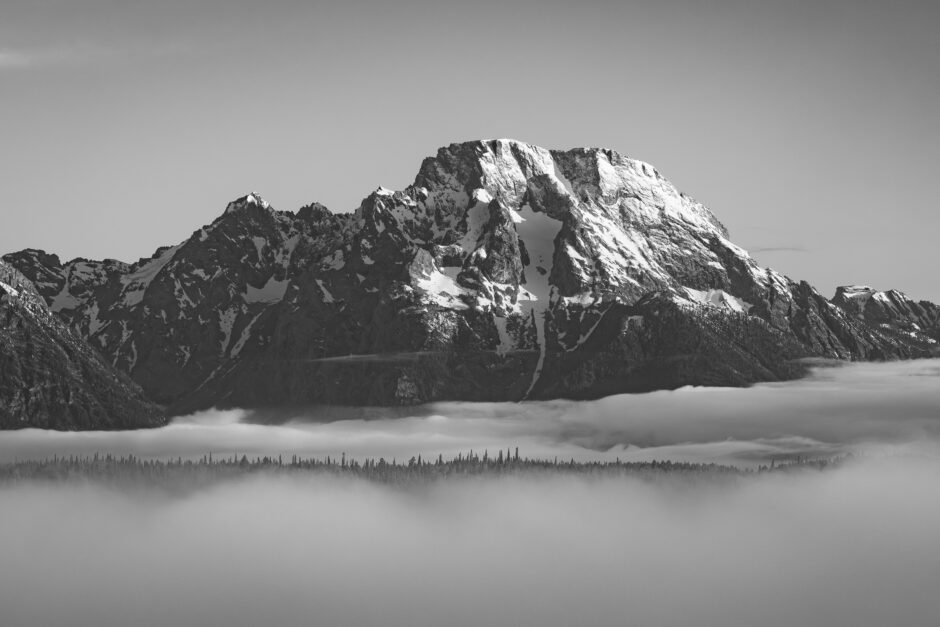
At sunrise, low clouds had settled across the valley floor while Mt. Moran rose completely above them, its snow-covered face catching the early light. The combination stripped away most of the visual clutter normally surrounding the mountain and turned the scene into something wonderfully simple: mountain, clouds, sky. Photography occasionally hands you a gift. Your job is mostly not to screw it up.
The Scene: Wait, Where Did Wyoming Go?
Low clouds and fog are fantastic landscape ingredients because they hide things.
Trees, roads, foothills and all the miscellaneous geographic clutter down below simply disappeared. Instead, the clouds created several soft horizontal layers beneath Mt. Moran, separating the mountain from the foreground and making it appear almost suspended in space.
Rather than fighting the conditions, I composed around them. The mountain occupies the upper portion of the frame while the clouds provide a soft foundation underneath. That contrast between razor-edged rock and smooth fog is really what makes the photograph work.
Why 66mm? Because Wider Wasn’t Better
I used a 24–70mm lens at 66mm.
It’s tempting in a place like Grand Teton to immediately reach for the widest lens possible. Huge mountains! Huge landscape! MUST INCLUDE EVERYTHING!
But wider would have made Mt. Moran smaller and introduced more empty foreground. At 66mm, I could isolate the mountain and compress those layers of clouds together, giving Moran much more visual authority in the frame.
The best landscape lens is not the one that shows you the most. It’s the one that leaves the unnecessary stuff out.
The Settings: Nothing Fancy Required
- Focal Length: 66mm
- Aperture: f/7.1
- Shutter Speed: 1/250 sec
- ISO: 250
At f/7.1, I had plenty of depth of field for a distant landscape while staying near the sweet spot of the lens.
The 1/250 sec shutter speed was comfortably fast for keeping the image sharp while shooting in changing morning conditions. Since the mountain was obviously not going anywhere—geology remains one of photography’s more cooperative subjects—I didn’t need an especially fast shutter.
And ISO 250 gave me the little bit of extra sensitivity needed to maintain that shutter speed without introducing any meaningful noise.
Going Black & White: Let the Mountain Do the Talking
This scene was already nearly monochromatic. Snow, dark rock, pale sky and layers of gray cloud were doing most of the work before I ever touched the saturation slider.
Converting it to black & white removed the remaining color distractions and emphasized what actually mattered: shape, texture, contrast and layers. High-contrast mountain scenes are especially well suited to monochrome because the bright snow and dark rock create strong graphic patterns on their own.
The resulting image feels less like a traditional sunrise photograph and more like Mt. Moran emerging from nowhere.
The Takeaway: Photograph the Weather, Not Despite It
Fog and low clouds can completely obscure a landscape. They can also transform one.
When conditions get weird, don’t automatically wait for them to “improve.” Look at what the weather is removing from the scene and what it is emphasizing instead. On this morning, the clouds hid almost everything except the one thing I wanted viewers to see.
On the Yellowstone & Grand Teton Photo Expedition, mornings around Grand Teton National Park can deliver exactly these sorts of rapidly changing conditions. You may head out hoping for a classic Teton sunrise and come home with something entirely different.
Which, photographically speaking, is usually a lot more fun.
Happy Photographing,


Leave a reply