What is the Best Lens for Photographing Wildlife in Alaska?
Although it’s a loaded question, it’s a critical consideration when prepping for a photo expedition in one of the wildlife hotspots of our planet. Do you go for the flexibility of a zoom telephoto? How much telephoto do you need? Will we be in copious low-light situations? These and more questions are covered in this deep dive on the topic of whether there is one lens to rule them all for wildlife photography in Alaska.
It’s Hard to Have it All
Before considering ‘the one lens’ that wins over all others, it’s important to talk about why this isn’t an easy concept to begin with.
In the world of lenses, you want them to have reach, versatility, speed (big maximum aperture), reasonable cost, and reasonable weight. The reality is…you don’t get to have all, at the same time, with the same lens.
In other words, if you want a lens that has great reach (i.e., long telephoto extent, like 400, 500, or 600mm) and speed, you probably won’t get to have versatility or a reasonable cost.
If you want the lens to be relatively light weight and versatile, you might sacrifice on reach and speed.
The point here is that there will always be some compromise. The key thing, though, is which things you really need for Alaska wildlife, and which things can be sacrificed.
In my opinion, you absolutely must have decent reach…at least 400mm at the upper end. And I really want it to be versatile (i.e., a zoom range, like 100-400mm vs. a fixed 400mm), as it helps photograph stunning sights and moments in a variety of ways. If you’re stuck at only one focal length, you may not get the same number nor variety of shots, which I think is paramount to successful and enjoyable nature photography.
So, if I get to have reach and versatility, what do I sacrifice? Well, mainly, I’m sacrificing speed…aperture. Do I settle begrudgingly? Yep…I WISH I could have a 100-500mm lens that was f/2.8, but it just doesn’t exist for most camera systems (caveat, OM Systems has a 50-200mm f/2.8, which ‘becomes’ a 100-400mm f/2.8 due to its crop factor, but it doesn’t have the same shallow depth of field as a typical f/2.8 lens…it’s a bit more like f/5.6).
Now what about price and weight? Well, this is where you get to make some choices. For most camera systems, they have an ‘introductory’ and ‘pro’ version of their wildlife-centric zoom telephotos in that 100-400 (or more) class. If you want the highest quality version, it’s going to be a bit more costly and a bit heavier, simply put.
The Best Lens
Ok, enough banter. Let’s get to the point.
Now that you know the above, and you recognize there is some compromise here, the best lens for Alaska features, in this order 1) telephoto extent of 400, 500 or 600mm, 2) has a zoom capability wide to 100 or 200mm, and 3) is good enough quality so that you will get the sharp images you expect, with some image stabilization, and the ability to crop if the occasion arises.
For each of the major camera systems, my recommendations are:
- Canon’s RF 100-500mm
- Nikon’s Z 180-600mm
- Sony’s FE 200-600mm
- OM System’s 50-200mm (which is actually like a 100-400mm)
You’ll see a few common threads here. These are all “pro” level lenses, they are all around $2500 USD (the OM one is a bit more), all have a hefty range, and all top out somewhere between 400 and 600mm. Another caveat is that if you shoot OM Systems, their 150-400mm (which is like a 300-800mm) is extraordinary, and if your style of photography is to fill the frame with wildlife each and every time (or wildlife faces) then it can be wonderful. However, the f/2.8 capabilities of OM’s 50-200 is really nice for keeping ISOs low (and is half the cost).
Low Light Isn’t as Much of a Problem
One thing you haven’t heard me talk about much yet is whether you need a fast aperture because of low light.
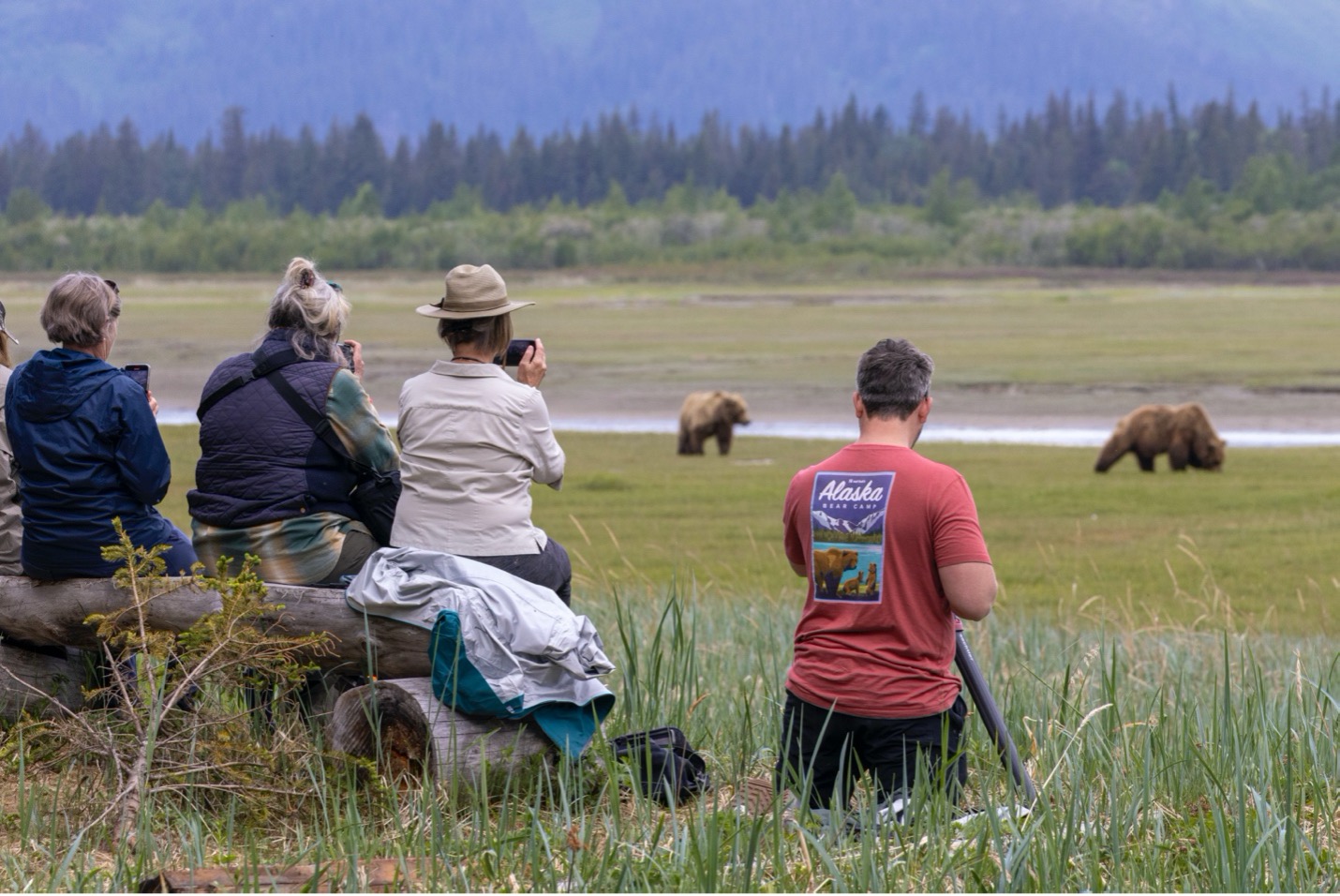
While there is always the occasion to photograph in low light in wild places around the world, it’s not a core feature of Alaska wildlife trips as much as, say, an African safari, where dawn and dusk tend to be highlights of the day. In Alaska, with its long days, diurnal wildlife like whales, bears, eagles, and everything in between, low light isn’t a cornerstone of your daily photography.
Now, what I do love is the background separation and shallow depth of field that occurs with a nice f/4 or f/2.8 lens. In addition, you can shoot faster, while keeping ISO in check, at these apertures, too.
However, if you insist on these ‘fast’ apertures (which I do not) you really are quite stuck with the big primes like the 400mm f/2.8, or 600mm f/4 lenses. Not only are these 3 to 4 times the cost, they are usually 3 to 4 times the size and weight, and, frankly, they are inflexible when compared to a zoom. Yes, you will get some stunning shots with them, but you may miss quite a few, too, because you can’t zoom out when wildlife is closer or you wish to nail a wildlife-in-landscape shot in the 100-200mm range.
Final Thoughts
These lens recommendations may not be surprising to you, and that likely comes as welcome news. This class of lenses is often the go-to for most wildlife photographers, as they provide excellent quality, versatility, and range, while being relatively compact and at a digestible price point (although I do admit that a $2500 lens is still expensive by traditional measure). Might you need to go a little higher on your ISO to freeze motion or shoot at lower light times of day? You bet. However, digital cameras have come a long way, such that ISO 1600, 3200, or even 6400 is very workable these days.
A final piece of advice is that you absolutely must still bring your favorite wide angle/landscape lens, like a 24-70mm or 24-105, as you’ll get key shots with those, too.
But if you’re headed on an Alaska photography adventure, pack your trusty 100-500, 180-600 or 200-600 lens first, and it’ll be your workhorse for 70% of your photos during the adventure.
Go forward and give it a shot,
Court

Leave a reply